

Why the Buffalo River Area Is a Stargazer's Paradise

Hansen Doolittle

Most Americans have never seen the night.

They've seen darkness — the kind softened by a porch light down the block, or punctured by the glow of a city forty miles off. But the night your great-grandparents stepped into on a Tuesday in 1923 has been bleached out of about 80% of the country. Four out of five Americans cannot see the Milky Way from where they live.


It's still here.


OZK Cabins sits on 550 private acres in Compton, Arkansas, less than 5 miles from the Buffalo National River — a certified International Dark Sky Park, one of fewer than 200 in the world. No streetlights. No neighboring property. No glow on the horizon. Just the sky doing what it has always done.

What makes this sky different

The night sky isn't a feature of the property. It's the second landscape — the one that arrives after dinner, fills every direction at once, and rewards the simple act of stepping outside.


What separates the upper Buffalo from the dark-sky locations you can drive to and stand in is permanence. The Buffalo National River's certification holds the surrounding corridor accountable for the kind of lighting it allows. There's no parking lot, no closing time, no city glow rising from the next county. Step onto the deck, and the sky is already there.


Three things conspire to make it work:


  • Geography. The upper Buffalo Valley sits in a low-population corridor with no major light dome within sight.
  • Preservation. The Buffalo National River's dark sky certification raises the bar for what counts as acceptable lighting in the surrounding region.
  • Isolation. 550 private acres means no neighboring porch lights, no security floodlights, no headlights threading through your view at 11 p.m.

What you'll actually see

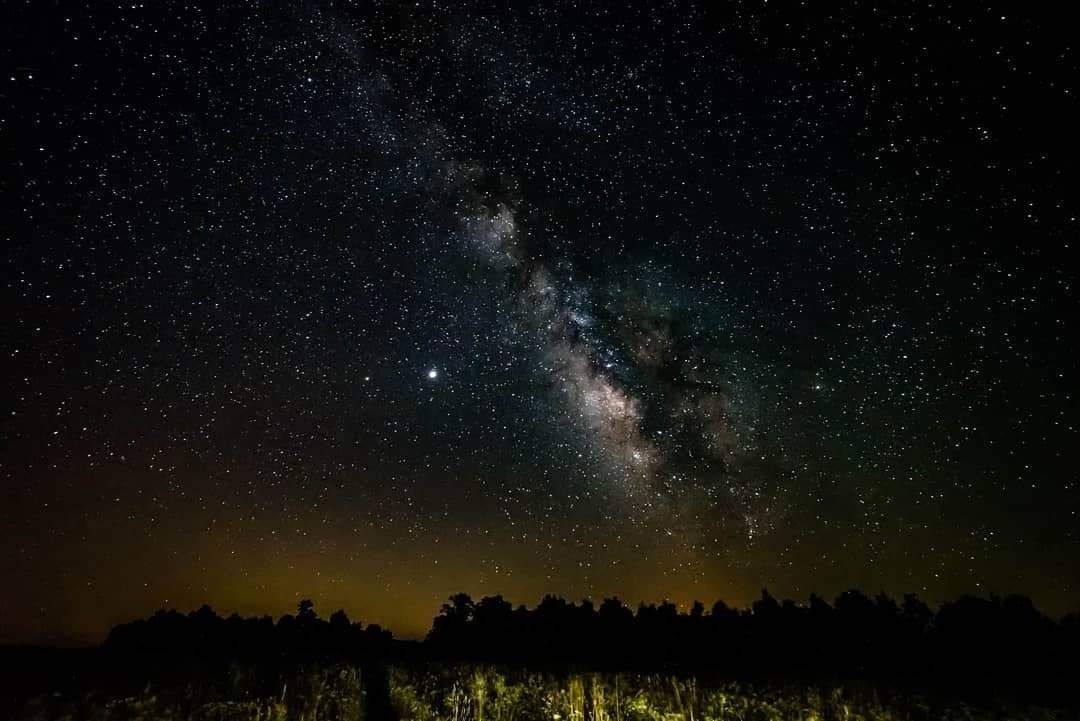
On a clear, moonless night between March and October, the galactic core of the Milky Way arcs from horizon to horizon. Not a smudge. A structure. You can trace it.


With the naked eye:

  • The Milky Way's full band, with visible dust lanes and brighter star clouds.
  • Andromeda — a galaxy 2.5 million light-years away — as a faint smudge in the autumn sky.
  • The Pleiades, Orion Nebula, and dozens of recognizable constellations.
  • Meteors on most clear nights, and during peak showers, one every minute or two if you're patient.

With a pair of 10x50 binoculars (the Celestron Cometron 7x50 is a common starter recommendation):

  • Jupiter's four largest moons, lined up beside the planet.
  • The structure of star clusters and brighter nebulae.
  • Hundreds of stars invisible to the naked eye.

With a small telescope:

  • Saturn's rings.
  • Lunar craters in real detail.
  • Deep-sky objects most city dwellers have never seen.

Give your eyes twenty minutes to fully adjust. Avoid white light during that window — a single phone glance starts the clock over. A red-filtered headlamp is the only artificial light worth using.

“COMING SOON” text on a light wall with green eucalyptus branches above

When to come

The Milky Way's core is visible roughly March through October, peaking in brightness from June through August. Outside those months, the sky is no less dark — it simply trades one kind of beauty for another.

March – May: the awakening

The galactic core begins rising in the late-night hours. Cool air, transparent skies, fewer visitors. Spring brings reliable meteor activity as the Earth crosses the dust trails of long-gone comets.

June – August: the peak

If you only get one night, make it summer. The Milky Way dominates the southern sky from dusk until dawn, brightest, highest, and most photogenic. Warm enough to lie on the deck for hours without shivering. The Perseid meteor shower (August 11–13) brings 50–80 meteors per hour at peak.

September – October: the long view

Many guests' favorite season. Cool, dry air. The galactic core is still visible at dusk and through the early evening. Crowds drop. The fall foliage on the surrounding ridges adds something the summer sky doesn't have.

December – February: the silent sky

The Milky Way is mostly absent, but winter brings the clearest, sharpest skies of the year. Orion, Sirius, the Pleiades. The Geminid meteor shower (December 13–14) delivers 60–120 per hour. Bring layers, and consider the hot tub.


The darkest nights are the new-moon nights. Plan around the lunar calendar if you want maximum visibility. Full-moon weekends are still beautiful — you just trade the Milky Way for a moonlit landscape and a different kind of quiet.

For photographers

You don't need professional equipment to capture the night sky here. A modern smartphone in night mode will do more than you'd expect. An entry-level DSLR with a fast lens will produce images that look like they were taken from a much more remote location than they actually were.


A working starting point:

  • Wide-angle lens, 14–24mm.
  • Aperture f/2.8 or wider.
  • 20–30 second exposures, ISO 1600 to 3200.
  • A sturdy tripod — camera movement is the difference between a portfolio shot and a blur.
  • A red-filtered headlamp, to preserve night vision while you set up.
  • RAW format, for editing flexibility later.

The Lodge deck has room for multiple tripods, and the property has several openings with unobstructed southern and southeastern exposure during Milky Way season. We're happy to share locations and settings that have worked for past guests — just ask before you arrive.

Why dark skies are worth preserving

Dark skies aren't a luxury. They're an ecological and cultural baseline.


Light pollution disrupts the migration patterns of birds and insects. It interferes with the reproductive cycles of nocturnal animals. It suppresses melatonin production in humans. It wastes a stunning amount of energy. And it erases something more difficult to measure — the connection between humans and the cosmos that shaped every culture, every calendar, every navigational tool, every story we ever told ourselves about why we're here.


The Buffalo National River's certification didn't happen by accident. It came from years of work by local conservation groups and residents who understood that the night sky is a finite resource. Once light pollution arrives, it almost never leaves.


OZK follows dark-sky-friendly principles for its outdoor lighting: warm color temperatures, full cutoff light fixtures, and minimal exterior illumination after dusk. We don't add to the light dome. We protect the conditions that make this sky possible.

The simple act of booking a dark sky stay supports preservation. When guests choose corridors like this one over light-polluted alternatives, it sends an economic signal to local communities and property owners weighing whether to protect the night sky or develop in ways that erase it.

Your first night

If you've never seen a true dark sky before, expect to be quieted by it.


Some guests step outside on the first evening and stop talking for ten minutes. Some sit down on the deck without meaning to. Some turn slowly in place because every direction looks like its own postcard. A few cry — not from sadness, just from the size of the thing.


The honest advice is simple. Step outside. Leave your phone inside. Give your eyes time to adjust. Lie down on the deck, or in the hot tub, or in a chair pulled out into the yard. Stay long enough that the cold or the stiffness becomes part of the memory. Most guests stay out longer than they planned to. Most book their next trip before they leave.

Cabin eave with a view of the night sky and stars

Come see it

We can describe it. We can show you photos. But the dark sky is the kind of thing that has to be stood underneath. It is not a feature you can preview on a screen. It is the sky doing what it has always done, and you, finally, in a position to notice.


Most guests describe their first night here as the moment the trip became something they couldn't have planned for. That's the part we can't put in a brochure.

Recent Posts

Black “COMING SOON” text on a beige background with green leaves at the top
By Owner April 28, 2026
Sed ut perspiciatis unde omnis iste natus error sit voluptatem accusantium doloremque laudantium, totam rem aperiam, eaque ipsa quae ab illo inventore veritatis et quasi architecto beatae vitae dicta sunt explicabo. Nemo enim ipsam voluptatem quia voluptas sit aspernatur aut odit aut fugit, sed quia consequuntur magni dolores eos qui

“COMING SOON” text on a light wall with green eucalyptus branches above
By Owner April 28, 2026
Sed ut perspiciatis unde omnis iste natus error sit voluptatem accusantium doloremque laudantium, totam rem aperiam, eaque ipsa quae ab illo inventore veritatis et quasi architecto beatae vitae dicta sunt explicabo. Nemo enim ipsam voluptatem quia voluptas sit aspernatur aut odit aut fugit, sed quia consequuntur magni dolores eos qui
Black “COMING SOON” text on a beige background with green leaves at the top
By Owner April 28, 2026
Sed ut perspiciatis unde omnis iste natus error sit voluptatem accusantium doloremque laudantium, totam rem aperiam, eaque ipsa quae ab illo inventore veritatis et quasi architecto beatae vitae dicta sunt explicabo. Nemo enim ipsam voluptatem quia voluptas sit aspernatur aut odit aut fugit, sed quia consequuntur magni dolores eos qui